Orix Time logo

How to Choose a Solar Watch in 2026 — Step-by-Step Practical Guide

Mateo Alvarez
Mateo Alvarez

Deals editor focused on watch bargains, market analysis, and approachable buying advice.

Published at March 27, 2026

Why this updated solar watch guide matters in 2026

Close-up of solar watches showing dials with solar cells, case materials and strap types, educational overlay indicating size and features

Why read this now (March 2026)?

Solar-powered watches continue to evolve: improved low‑light sensitivity, more compact modules, and manufacturers offering longer guaranteed reserves. This update focuses on practical decision-making for buyers who want a watch that works reliably in real life — not just on glossy specs. The goal is to give you a reproducible method to choose a solar watch that matches your lifestyle, budget and expectations for durability.

At a glance — what this guide gives you:

  • A clear, step‑by‑step selection method.
  • Practical checks to differentiate marketing claims from meaningful specs.
  • Updated considerations for indoor charging, modern module sensitivity and serviceability.

Quick comparison table

Decision stepWhat to checkWhy it matters
Define useSport / daily / travel / formalMatches features to real needs
MaterialsSteel, titanium, resin, crystal typeLongevity and scratch/impact resistance
Charging behaviorLow‑light sensitivity, charge indicatorPredicts real autonomy at your lifestyle
Service & warrantyParts, service centersLong‑term ownership costs

How to use this guide

  1. Read the sections in order — they build a decision checklist.
  2. Jot down your must‑haves (water resistance, reserve, legibility).
  3. Cross‑reference with product pages and category overviews — for curated model lists see the Solar watches overview.

This guide is editorially neutral: we explain how to weigh trade‑offs rather than push particular brands. For buyers in French speaking regions, consult the companion category page Montres solaires for locally relevant model references and availability.

Read on to convert preferences into a shortlist that you can test in‑store or verify online with targeted questions.

Discover our best references

* price updated at March 30, 2026
Casio G-Shock GW-M5610U-1 Men's Solar Black Resin Sport Watch

Casio

Casio G-Shock GW-M5610U-1 Men's Solar Black Resin Sport Watch
★★★★☆4.7

$110.26

$165.00

-33 %

*
Casio MTPS120L Series | Unisex Analog Watch | 100M WR | Stainless Steel Case | 3 Hand Analog (HR, Min, SEC) | Date Display | Low Battery Alert | Military Styling | Solar Powered

Casio

Casio MTPS120L Series | Unisex Analog Watch | 100M WR | Stainless Steel Case | 3 Hand Analog (HR, Min, SEC) | Date Display | Low Battery Alert | Military Styling | Solar Powered
★★★★☆4.5

$107.26

$160.00

-33 %

*
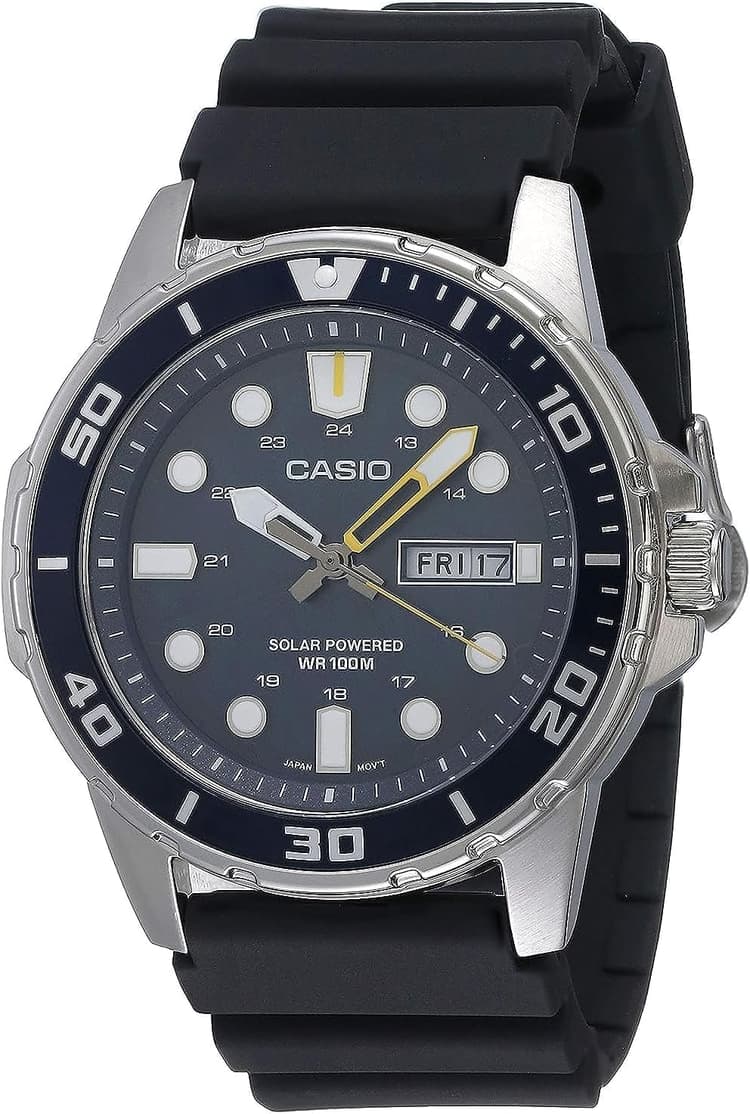
Casio MTPS110 Series | Unisex Analog Watch | 100M WR | Stainless Steel Case | 3 Hand Analog (HR, Min, SEC) | Date Display | Low Battery Alert | Diver Inspired Styling | Solar Powered

Casio

Casio MTPS110 Series | Unisex Analog Watch | 100M WR | Stainless Steel Case | 3 Hand Analog (HR, Min, SEC) | Date Display | Low Battery Alert | Diver Inspired Styling | Solar Powered
★★★★☆4.5

$107.26

$160.00

-33 %

*
Casio SGW100 Series | Digital Watch & Compass | 200M WR | 100 SEC Stopwatch | Twin Sensor for Direction & Temperature | Low Temp Resistant | World Time | Auto Calendar | Multi Alarm

Casio

Casio SGW100 Series | Digital Watch & Compass | 200M WR | 100 SEC Stopwatch | Twin Sensor for Direction & Temperature | Low Temp Resistant | World Time | Auto Calendar | Multi Alarm
★★★★☆4.5

$56.26

$79.95

-30 %

*
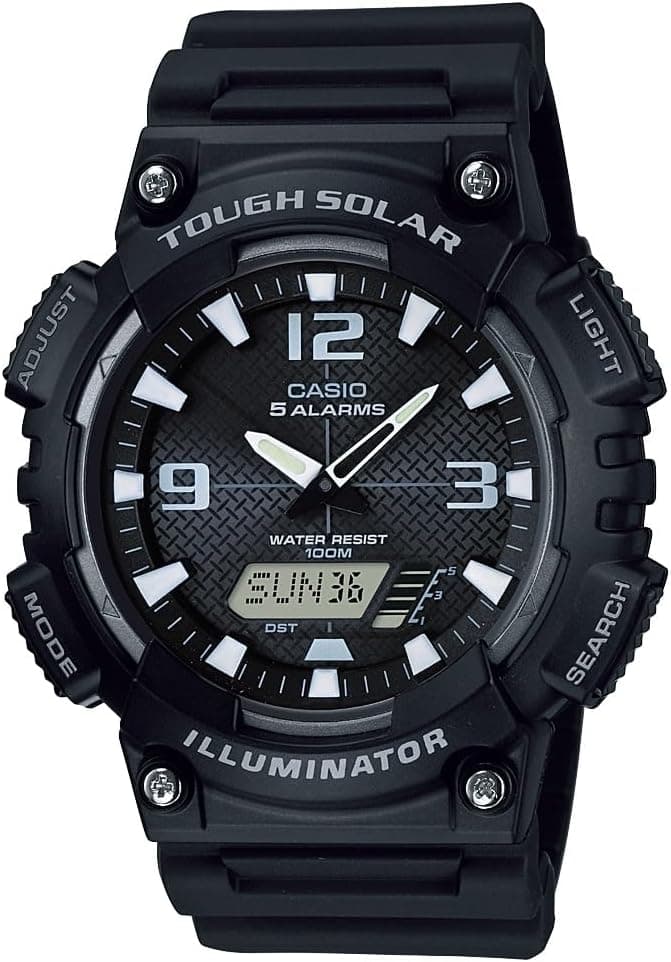
Casio AQS800W Series | Analog Digital Watch | 100M WR | Solar Powered | 1/100 SEC Stop Watch | 6-Language Day of The Week Indicator | Countdown Timer | LED Light | Multi Alarm

Casio

Casio AQS800W Series | Analog Digital Watch | 100M WR | Solar Powered | 1/100 SEC Stop Watch | 6-Language Day of The Week Indicator | Countdown Timer | LED Light | Multi Alarm
★★★★☆4.5

$49.97

$64.95

-23 %

*
Citizen Men's Eco-Drive Weekender Garrison Field Watch in Stainless Steel, Black Dial, Arabic Markers, Luminous, 43mm (Model: AW0050-82E)

CITIZEN

Citizen Men's Eco-Drive Weekender Garrison Field Watch in Stainless Steel, Black Dial, Arabic Markers, Luminous, 43mm (Model: AW0050-82E)
★★★★☆4.5

$147.00

$173.95

-15 %

*
Casio AQ-S820W Series

Casio AQ-S820W Series
★★★★☆4.4

$55.76

$64.95

-14 %

*
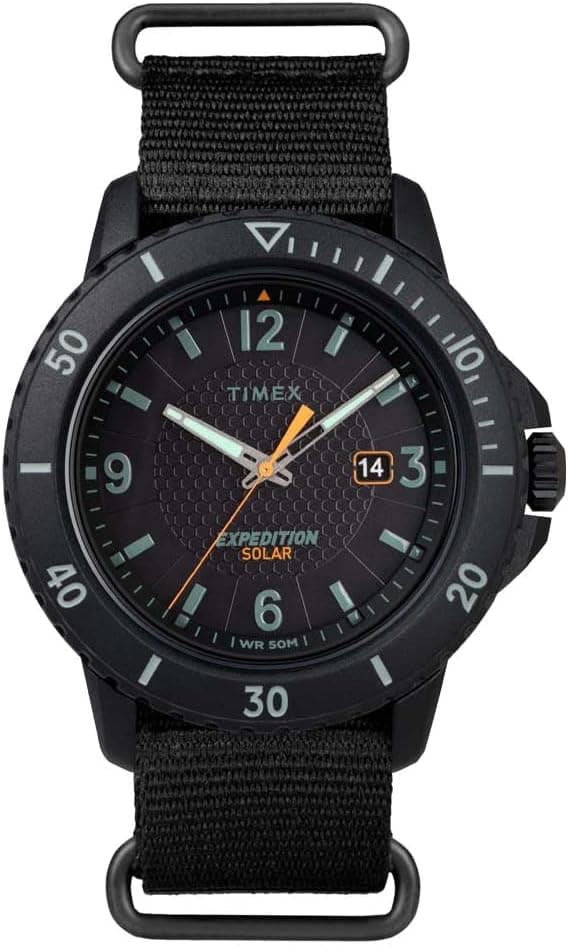
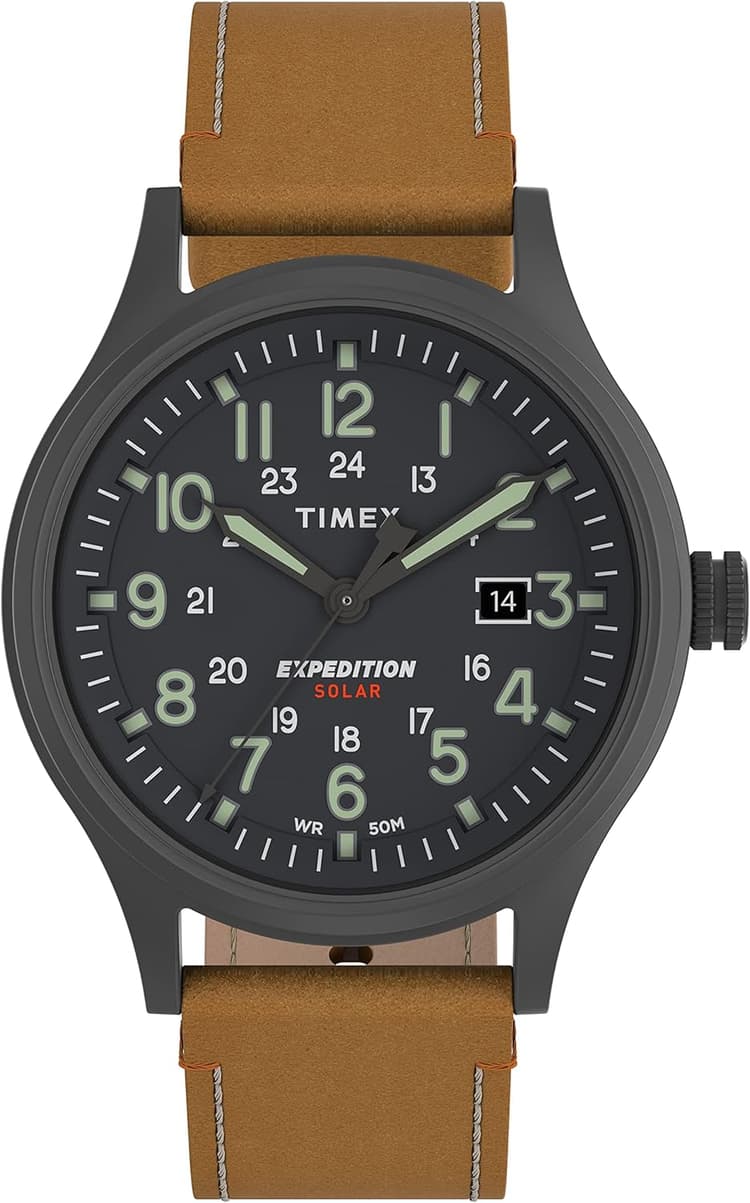
Timex Men's Expedition Scout 40mm Watch

Timex

Timex Men's Expedition Scout 40mm Watch
★★★★☆4.3

$49.70

$56.80

-13 %

*
Casio A158WA Series | Unisex Digital Watch | Vintage | WR | 100 SEC Stop Watch | Daily Alarm | Regular Time Keeping: Hour, Minute, Second, PM, Date, Day | Led Light | 7 Yr Battery

Casio

Casio A158WA Series | Unisex Digital Watch | Vintage | WR | 100 SEC Stop Watch | Daily Alarm | Regular Time Keeping: Hour, Minute, Second, PM, Date, Day | Led Light | 7 Yr Battery
★★★★☆4.6

$29.79

*
Casio F91W Series | Digital Watch | Water Resistant | LED Light | 1/100 SEC Stopwatch | Regular Time Keeping (HR, Min, SEC, PM, Date, Day) | Daily Alarm | Lightweight | 7 Year Battery

Casio

Casio F91W Series | Digital Watch | Water Resistant | LED Light | 1/100 SEC Stopwatch | Regular Time Keeping (HR, Min, SEC, PM, Date, Day) | Daily Alarm | Lightweight | 7 Year Battery
★★★★☆4.6

$19.61

*
Garmin Instinct 2X Solar - Tactical Edition, Rugged GPS Smartwatch, Built-in Flashlight, Ballistics Calculator, Solar Charging Capability, Coyote Tan

Garmin

Garmin Instinct 2X Solar - Tactical Edition, Rugged GPS Smartwatch, Built-in Flashlight, Ballistics Calculator, Solar Charging Capability, Coyote Tan
★★★★☆4.7

$499.99

*
Garmin Instinct® 3 45mm, Solar Charged Display, Rugged Outdoor GPS Smartwatch, Metal-Reinforced Bezel, Built-in Flashlight, Black

Garmin

Garmin Instinct® 3 45mm, Solar Charged Display, Rugged Outdoor GPS Smartwatch, Metal-Reinforced Bezel, Built-in Flashlight, Black
★★★★☆4.6

$399.99

*

Assessing your needs: convert intentions into measurable priorities

Start with behaviour, not the product.

Rather than browsing by aesthetics first, list specific situations where you will wear the watch. Concrete scenarios reveal which technical features actually matter. Below is a practical checklist you can complete in two minutes and reuse when comparing models.

Practical checklist (fill this for yourself)

  • Primary contexts: office / outdoor work / gym / travel / diving / formal events.
  • Typical light exposure: mostly indoor / mixed / mostly outdoor.
  • Tolerance for size/weight: must be slim / average / don't mind bulky.
  • Strap preferences: leather / metal bracelet / rubber / easily replaceable.
  • Must‑have features: water resistance (specify ATM), charge indicator, GMT, chronograph, radio/GPS sync.

How each choice maps to product specs

  • Mostly indoor → prioritize high solar sensitivity and a charge indicator; some modern modules charge under strong office light.
  • Outdoor work or hiking → choose robust case materials (treated steel, titanium or resin), higher water resistance and reinforced crystals.
  • Frequent travel → consider GMT or dual‑time features and easy strap interchangeability for packing comfort.

Decision matrix (example)

Use caseTop prioritiesReasoning
Office / formalSlim profile, legibility, refined finishLooks and under‑cuff comfort matter
Outdoor / hikingShock resistance, readable dial, solar sensitivityReliability in varying light and knocks
Gym / water sports10–20 ATM, rubber strap, lumeSweat and water exposure demand durability

Once you have answers, filter technical specs against them. For model suggestions that align with specific uses, cross‑check the Solar watches overview for comparative guidance and examples. Keep your checklist on hand when reading product pages — it prevents being swayed by color or dial layout alone.

Finally, remember needs shift: if you expect more outdoor activity in the next 2–3 years, bias your choice towards durability and serviceability rather than short‑term fashion.

Understanding pricing levels and what drives them

Solar watches span a broad price spectrum. Rather than memorizing fixed ranges, focus on the factors that explain cost differences:

  • Movement and electronics: complexity (simple solar quartz vs multi-function solar chronograph) strongly affects price. Modules with extra functions (alarm, GMT) cost more.
  • Case and crystal materials: stainless steel typically costs more than resin; titanium and sapphire crystal raise price but improve durability.
  • Water resistance and construction: watches rated for diving or higher water resistance require pricier seals and engineering.
  • Brand and aftercare: reputation and service policies add a premium, including easier repairs.

Pricing tiers in practice:

  • Entry-level practical: simple solar models, resin or basic steel cases, mineral crystal. Good value for daily wear.
  • Mid-range: more complete movements, better materials (brushed steel, reinforced glass), additional features.
  • Premium: titanium, sapphire crystal, complex modules, high water resistance, refined finishing.

Pros and cons: higher price often brings improved durability and serviceability, but value depends on priorities. For heavy outdoor use, a sturdier build is rational; for occasional wear, a mid-range option may be sufficient. Always check warranty and parts availability before raising your budget.

Size and comfort: choosing the right dimensions

Case diameter, thickness and strap type determine daily comfort. Use this practical checklist:

  • Measure your wrist: circumference is the starting point. Cases around 36-40 mm generally suit slimmer wrists, 40-44 mm fit many men's or unisex wrists, and over 44 mm for a bolder or technical look. These are guidelines, not absolutes.
  • Mind lug width: the strap width affects balance. A wide strap on a small wrist looks heavy; a narrower lug width helps proportion.
  • Check thickness: rugged solar modules can increase thickness. If you wear dress shirts, a slimmer profile improves comfort and shirt fit.
  • Test the strap material: metal, leather and rubber behave differently. Metal looks refined but adds weight; rubber is light and sport-friendly; leather is comfortable but sensitive to moisture.

Trade-offs: a larger case improves legibility and presence but can be heavy on smaller wrists. Adjustable bracelets often mitigate discomfort. Try models in-store when possible, or compare dimensions and wearer photos online to estimate fit if buying remotely.

Materials and durability: read specs critically and test assumptions

Durability is a set of trade‑offs.

Material choices directly affect weight, scratch and impact resistance, as well as the long‑term appearance of a watch. When evaluating claims like "tough" or "rugged", translate them into verifiable specs and realistic expectations. Below are pragmatic checks and a quick decision table to help you prioritise.

Key material checks

  • Case metal: 316L stainless steel is widespread and durable; titanium offers weight savings and corrosion resistance but can be costlier; resin excels for shock resistance and low weight but reads as less premium.
  • Crystal: sapphire is best for scratch resistance and longevity; mineral or hardened mineral can be acceptable for sport models if paired with protective bezel design.
  • Coatings: PVD/DLC improve scratch resistance but can show wear over time — check if coating repairs are supported by the brand.
  • Seals & crowns: a screw‑down crown and defined ATM rating are meaningful; also check whether the watch is tested to ISO standards for diving when applicable.

Trade‑off table

PriorityRecommended materialsNotes
Lowest cost dailyHardened mineral, stainless steelGood value; expect visible wear over years
Sport/outdoorResin or treated steel, mineral reinforcedLightweight and shock‑tolerant; easier to replace
Long life & appearanceSapphire, stainless 316L or titaniumHigher upfront cost; preserves look and resale value

Practical tests and questions to ask

  • Ask if sapphire has an anti‑reflective (AR) treatment and whether AR is internal or external.
  • Check whether the brand publishes service intervals and parts availability in your region.
  • Inspect close‑up photos and video reviews for finishing quality — misaligned indices, cheap lume or loose spring bars are red flags.

For balanced selections and example models in different durability categories, review curated comparisons on the Solar watches overview. In short: match materials to intended abuse levels and expected lifespan; a premium material set buys you appearance and repairability, whereas sport materials buy shock tolerance and low weight.

Comparing essential features — a usability‑first glossary

Focus on usefulness, not feature lists.

A feature is only valuable if it improves your daily use. Below is a concise glossary explaining real‑world impact and how to test whether a feature is implemented well. Use this when reading spec sheets or watching hands‑on reviews.

Feature glossary and practical tests

  • Charge indicator — Shows remaining energy state. Why it matters: prevents surprise stops, especially for low‑exposure wearers. Test: check photos or video showing the indicator states and read user reports about false readings.
  • Power reserve — Time the watch runs without light. Why it matters: longer reserves offer buffer during low‑light seasons or storage. Test: look for user tests that report reserve after a real exposure cycle.
  • Chronograph — Timing using hands or subdials. Why it matters: essential for sports or work timing. Test: ensure pushers operate crisply and resets are precise.
  • GMT / second time zone — Useful for travellers. Why it matters: tells local and home time at a glance. Test: verify ease of setting and whether hour hand jumps independently.
  • Radio / GPS sync — Automatic time correction. Why it matters: eliminates manual setting; great for people who demand exactness. Test: confirm region compatibility (radio) or satellite behavior (GPS).
  • Luminescence — Night readability. Why it matters: real legibility in low light. Test: check post‑exposure glow tests in reviews.

Ergonomics beats specs

  • Buttons that are hard to press, crowded dials, or tiny subdials degrade a feature's value. Prioritise ergonomic implementation over a long spec list.

Decision guidance

  • If you rarely go outside, rank charge indicator and high solar sensitivity above chronograph or GMT.
  • If you travel frequently, place GMT and automatic sync higher on the list.

For model comparisons focused on which feature sets are balanced for everyday use, consult the curated Solar watches overview. Use the glossary above as a checklist while reading reviews — mark each feature "useful", "nice to have", or "irrelevant" to narrow options quickly.

Evaluating everyday performance

Everyday performance is judged across several concrete axes. For a pragmatic assessment, do the following:

  • Real-world autonomy: look for owner reports stating reserve duration after a normal week of exposure. Manufacturer figures are helpful but often measured under ideal conditions.
  • Light charging responsiveness: some watches charge with minimal light; others need direct sunlight. If you work mostly indoors, prefer models with high solar sensitivity.
  • Accuracy: solar quartz typically has low daily drift, but check for radio or GPS sync options for perfect accuracy.
  • Resistance to daily wear: assess resistance to abrasion, dust and moisture by reading material specs and water resistance claims.
  • Maintenance and repairability: ask about parts availability, ease of strap replacement and access to service centers.

Practical tips: read user reports that mirror your intended use (office, travel, sport). Remember how you wear and store the watch affects solar charging: a watch left in a drawer will lose reserve quickly. Also watch for warning signs like fading lume, which may point to aging of the module or luminous coating.

Common beginner mistakes and how to avoid them

Beginners often make predictable mistakes. Spotting them helps you decide more confidently:

  • Focusing only on looks: a handsome watch may not suit your use. Check water resistance, durability and autonomy before buying for appearance.
  • Ignoring legibility: small numerals, thin hands or highly reflective crystals reduce usefulness in real conditions. Inspect in-situ photos or try the watch to assess readability.
  • Underestimating the strap: an uncomfortable or non-standard strap makes a watch unpleasant and costly to replace. Check lug width and availability of compatible straps.
  • Overestimating solar charging: some assume solar watches always charge adequately; indoor efficiency can be limited. Look for solar sensitivity specs and a charge indicator if you spend much time inside.
  • Thinking more features are always better: unnecessary functions complicate use and can increase energy use. Prioritize simplicity when reliability and readability matter.

How to avoid these traps: define needs first, match specs to those needs, read detailed reviews and, if possible, try in person. Use a pedagogical approach: compare two or three models, listing each one's pros and cons relative to your intended use.

Discover our top deals references

* price updated at March 30, 2026
See more
Casio G-Shock GW-M5610U-1 Men's Solar Black Resin Sport Watch

Casio

Casio G-Shock GW-M5610U-1 Men's Solar Black Resin Sport Watch
★★★★☆4.7

$110.26

$165.00

-33 %

*
Casio A158WA Series | Unisex Digital Watch | Vintage | WR | 100 SEC Stop Watch | Daily Alarm | Regular Time Keeping: Hour, Minute, Second, PM, Date, Day | Led Light | 7 Yr Battery

Casio

Casio A158WA Series | Unisex Digital Watch | Vintage | WR | 100 SEC Stop Watch | Daily Alarm | Regular Time Keeping: Hour, Minute, Second, PM, Date, Day | Led Light | 7 Yr Battery
★★★★☆4.6

$29.79

*
Casio F91W Series | Digital Watch | Water Resistant | LED Light | 1/100 SEC Stopwatch | Regular Time Keeping (HR, Min, SEC, PM, Date, Day) | Daily Alarm | Lightweight | 7 Year Battery

Casio

Casio F91W Series | Digital Watch | Water Resistant | LED Light | 1/100 SEC Stopwatch | Regular Time Keeping (HR, Min, SEC, PM, Date, Day) | Daily Alarm | Lightweight | 7 Year Battery
★★★★☆4.6

$19.61

*
Garmin Instinct 2X Solar - Tactical Edition, Rugged GPS Smartwatch, Built-in Flashlight, Ballistics Calculator, Solar Charging Capability, Coyote Tan

Garmin

Garmin Instinct 2X Solar - Tactical Edition, Rugged GPS Smartwatch, Built-in Flashlight, Ballistics Calculator, Solar Charging Capability, Coyote Tan
★★★★☆4.7

$499.99

*
Casio SGW100 Series | Digital Watch & Compass | 200M WR | 100 SEC Stopwatch | Twin Sensor for Direction & Temperature | Low Temp Resistant | World Time | Auto Calendar | Multi Alarm

Casio

Casio SGW100 Series | Digital Watch & Compass | 200M WR | 100 SEC Stopwatch | Twin Sensor for Direction & Temperature | Low Temp Resistant | World Time | Auto Calendar | Multi Alarm
★★★★☆4.5

$56.26

$79.95

-30 %

*
Casio AQS800W Series | Analog Digital Watch | 100M WR | Solar Powered | 1/100 SEC Stop Watch | 6-Language Day of The Week Indicator | Countdown Timer | LED Light | Multi Alarm

Casio

Casio AQS800W Series | Analog Digital Watch | 100M WR | Solar Powered | 1/100 SEC Stop Watch | 6-Language Day of The Week Indicator | Countdown Timer | LED Light | Multi Alarm
★★★★☆4.5

$49.97

$64.95

-23 %

*
Casio MTPS120L Series | Unisex Analog Watch | 100M WR | Stainless Steel Case | 3 Hand Analog (HR, Min, SEC) | Date Display | Low Battery Alert | Military Styling | Solar Powered

Casio

Casio MTPS120L Series | Unisex Analog Watch | 100M WR | Stainless Steel Case | 3 Hand Analog (HR, Min, SEC) | Date Display | Low Battery Alert | Military Styling | Solar Powered
★★★★☆4.5

$107.26

$160.00

-33 %

*
Garmin Instinct® 3 45mm, Solar Charged Display, Rugged Outdoor GPS Smartwatch, Metal-Reinforced Bezel, Built-in Flashlight, Black

Garmin

Garmin Instinct® 3 45mm, Solar Charged Display, Rugged Outdoor GPS Smartwatch, Metal-Reinforced Bezel, Built-in Flashlight, Black
★★★★☆4.6

$399.99

*
Casio MTPS110 Series | Unisex Analog Watch | 100M WR | Stainless Steel Case | 3 Hand Analog (HR, Min, SEC) | Date Display | Low Battery Alert | Diver Inspired Styling | Solar Powered

Casio

Casio MTPS110 Series | Unisex Analog Watch | 100M WR | Stainless Steel Case | 3 Hand Analog (HR, Min, SEC) | Date Display | Low Battery Alert | Diver Inspired Styling | Solar Powered
★★★★☆4.5

$107.26

$160.00

-33 %

*
Citizen Men's Eco-Drive Weekender Garrison Field Watch in Stainless Steel, Black Dial, Arabic Markers, Luminous, 43mm (Model: AW0050-82E)

CITIZEN

Citizen Men's Eco-Drive Weekender Garrison Field Watch in Stainless Steel, Black Dial, Arabic Markers, Luminous, 43mm (Model: AW0050-82E)
★★★★☆4.5

$147.00

$173.95

-15 %

*
Timex Men's Expedition Scout 40mm Watch

Timex

Timex Men's Expedition Scout 40mm Watch
★★★★☆4.3

$49.70

$56.80

-13 %

*
FANMIS Men's Solar Powered Casual Quartz Wrist Watch Analog Digital Multifunctional Black Sports Watch

FANMIS

FANMIS Men's Solar Powered Casual Quartz Wrist Watch Analog Digital Multifunctional Black Sports Watch
★★★★☆4.2

$19.99

*

Summary and next steps — convert knowledge into a shortlist

What to do next (practical checklist)

You now have the decision tools: define use, map needs to specs, prioritise materials and features, and evaluate everyday performance. Convert that into action with this compact sequence that will produce a reliable shortlist and avoid buyer's remorse.

  1. Measure your wrist and record comfort constraints (wrist circumference, cuff clearance).
  2. Complete the one‑page checklist from the "Assessing your needs" section.
  3. Filter models by your hard constraints (ATM rating, case diameter, strap type).
  4. From the filtered list, eliminate models that fail basic durability checks (crystal type, case material, crown type).

A short decision table to finalize choices

Final stageMust be trueIf not true — action
Fit & comfortCase diameter/thickness acceptableTry in store or drop from shortlist
Charging behaviourCharge indicator or proven low‑light sensitivityPrefer model with stronger module or pick alternate daily wearer
DurabilityMaterial specs match use (sapphire/titanium for long life)Accept compromises only if budget or style dictates
AftercareWarranty & parts available in your regionContact brand or authorised reseller before purchase

Testing & purchase tips

  • Try the watch on for at least five minutes: feel how it sits, how bracelets clasp and whether pushers interfere with movement.
  • Check real‑world owner reports for reserve and charging behaviour matching your lifestyle.
  • If buying online, confirm return policy, warranty terms and local service options.

For curated comparisons that map specific models to use cases, consult the Solar watches overview or the French selection page Montres solaires for local availability. Following these steps — and prioritising real‑world checks over marketing claims — will yield a solar watch that fits your life, lasts longer and requires less maintenance.

Frequently asked questions about solar watches

Editorial transparency

This guide was written to provide a pedagogical approach to buying solar watches. No specific brands or products are promoted; recommendations are based on commonly accepted technical and usage criteria. Information comes from public sources, technical sheets and user feedback. We do not present proprietary data or internal lab tests. The aim is to help readers define priorities and interpret specifications for an informed purchase.

  • Independent Watch Analysis

    Tests and articles by watch experts, based on technical criteria and side‑by‑side comparisons.

  • Impartial Watch Comparisons

    We compare models and features to inform your choice, free from commercial influence.

  • Verified, Up‑to‑Date Information

    Guides are regularly updated to reflect new releases and market developments.

  • Transparent Affiliate Links

    We may earn a commission from links to partner retailers; this does not affect our independent analyses.